

Your first home doesn't have to feel out of reach
Buying your first home? We're here to make it easier!
We know getting into the property market is exciting and can be a little overwhelming. That’s why we’ve pulled together everything you need to know, all in one place.
You’ll find easy-to-follow guides, useful articles, and answers to the questions first-home buyers ask most. From tips on saving for a deposit to what actually happens on settlement day, we’ve got you covered.
Wherever you’re at in the journey, we’re here to help you move forward with confidence.
Australian Government 5% Deposit Scheme
What is the Scheme?
The Australian Government 5% Deposit Scheme (the scheme) makes home ownership more achievable by helping you buy sooner with a smaller deposit, supported by a Government guarantee.
The best part? There are no income caps, no waitlists and no LMI, which means you will have lower upfront costs and could own your first home sooner than you thought!
What are the key features of the scheme?
- Low deposit options
- No income cap
- No Lenders Mortgage Insurance (LMI)
- Wide choice of home types
- Government-backed support: A Government guarantee is provided to the lender for your loan
- Unlimited spots and no waiting lists
- Purchase a property up to the property price caps set by the Scheme for your location
Australian Government 5% Deposit Scheme and Fact Sheets
- Australian Government 5% Deposit Scheme - Fact Sheet
- Australian Government 5% Deposit Scheme - First Home Buyers Information Guide
- Australian Government 5% Deposit Scheme - Single Parent Information Guide
Who is eligible for the Australian Government 5% Deposit Scheme?
- Borrowers must have a minimum 5% deposit. (It’s important to remember that stamp duty and legal fees aren’t covered by the scheme)
- Borrowers must be buying a home in Australia priced at, or below the location’s price cap.
- Borrowers must be Australian citizens or permanent residents.
- Borrowers must be applying as individual or joint applications. Joint applicants can be partners, friends, siblings, and other family members.
- Borrowers must be planning to live in the home as an owner-occupied property. The property cannot be used for investment purposes.
- All borrowers must be first home buyers or previous home owners who haven’t owned a property in the ten years prior to the date they execute their Coastline Bank home loan. The definition of ‘prior property ownership’ includes freehold interest in property in Australia (including land only), an interest in a leas of land in Australia with a term of 50 years or more, or a company title interest in land in Australia.
What are the property price caps?
Government legislation sets maximum purchase prices for eligible properties purchased under the Australian Government 5% Deposit Scheme. These property price caps are the same for all Scheme Guarantees. To understand more about the property price caps, follow the link below to the Property Price Cap Tool on the Australian Government First Home Buyers website. This tool will assist you in searching by postcode to help you determine the property price caps for the suburb you are looking to purchase in.
Are you on the journey to home ownership? Here's what you need to know!
Still Saving
When you buy a home, the deposit is just one part of the upfront costs. Other costs can include Transfer duty (stamp duty), or other Government transfer/registration duties. You should also consider the legal or conveyancing fees, title registration, building inspection, loan application fees, valuation fees and possibly lenders’ mortgage insurance (LMI) if your deposit is below a certain threshold.
When you buy a home, the deposit is just one part of the upfront costs. Other costs can include Transfer duty (stamp duty), or other Government transfer/registration duties. You should also consider the legal or conveyancing fees, title registration, building inspection, loan application fees, valuation fees and possibly lenders’ mortgage insurance (LMI) if your deposit is below a certain threshold.
How much you need depends on the property purchase price, your borrowing capacity and how much you want to borrow. As a general guide, a “typical” deposit is around 20% of the purchase price. If you buy a home worth $600,000, that means $120,000.
At Coastline Bank, we recommend you work backwards from the property price — research what homes cost in your target area, then factor in a realistic deposit + buffer for all upfront costs + enough savings for living expenses while you settle in.
LVR stands for Loan to Value Ratio. It’s how much you borrow (the loan amount) divided by the value (or purchase price) of the property.
So for example, if you buy a home valued at $500,000 and borrow $400,000, your LVR = 400,000 ÷ 500,000 = 80%.At Coastline Bank, LVR helps determine not only whether your loan is approved but also what interest rate or loan terms you might receive.
There sure are. If you’re a buyer in New South Wales there are a few key schemes that might apply.
A well-known option is the First Home Buyers Assistance Scheme (FHBAS). If you’re eligible and buying an existing or new home, or vacant land to build on, you could receive a full or partial transfer-duty (stamp duty) exemption.
We always encourage first home buyers to explore whether they’re eligible for these schemes.
Combining a home loan with available grants/concessions can significantly reduce the money you need upfront.There’s lots you can do to fast track your savings! Here’s a few simple tips:
- Set a clear savings goal. Decide roughly how much you need for your deposit and upfront costs. Then break that down into monthly (or fortnightly) savings targets.
- Automate your savings. Put savings on ‘autopilot’ by setting up automatic transfers to a dedicated savings account (so you treat saving like a regular bill).
- Use a high-interest savings account (or offset/locked savings account if available) so your savings earn more interest over time.
- Reduce expenses and debt. Review non-essential spending (subscriptions, frequent take-outs, etc.) and pay off high-interest debt.
Have a deposit
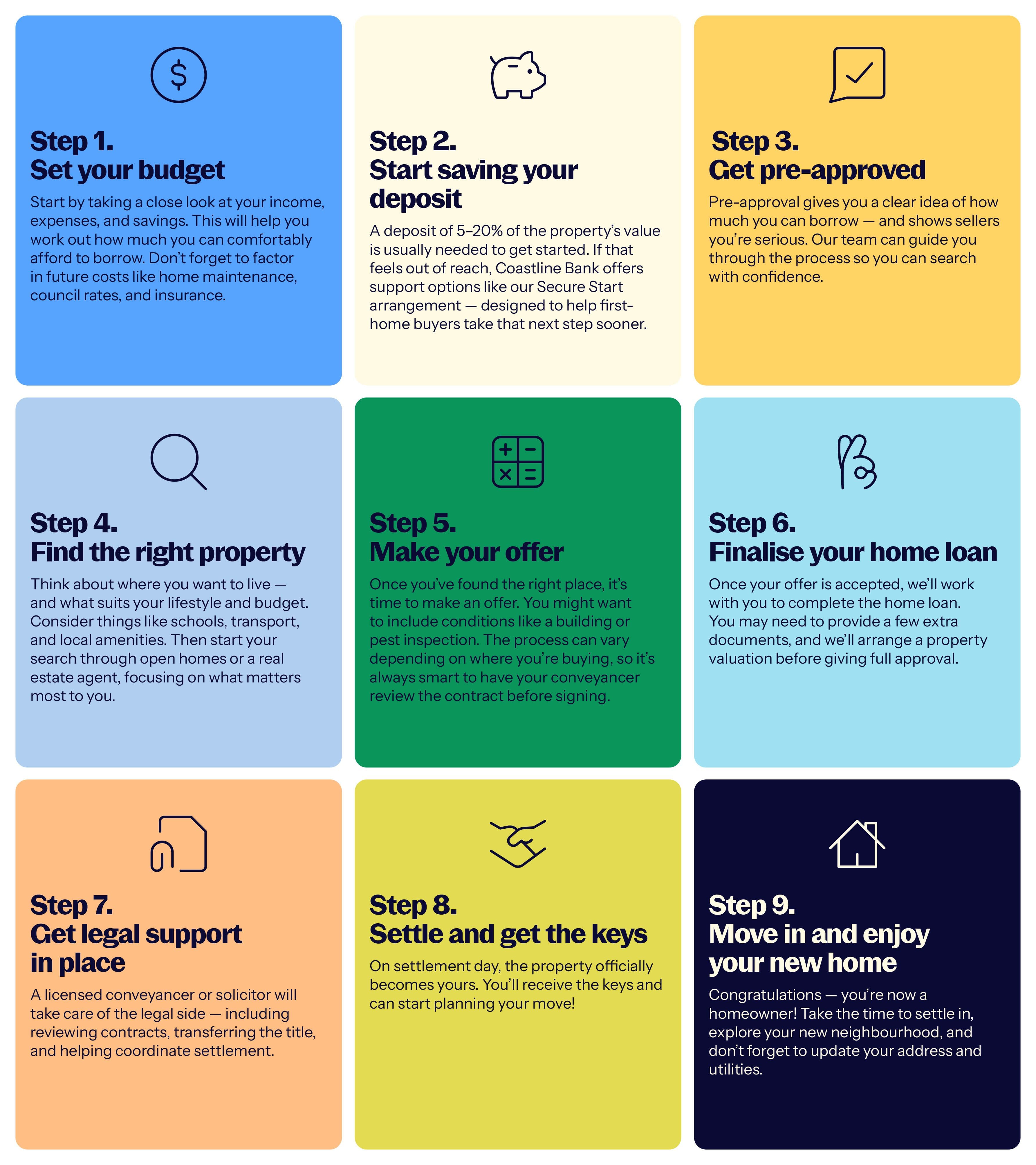
Pre-approval is basically a lender saying, “Yep, based on what you’ve told us, we’re comfortable lending you up to this amount.”
It’s not a full approval yet, but it gives you a solid idea of your budget before you start making offers.
Pre-approval is basically a lender saying, “Yep, based on what you’ve told us, we’re comfortable lending you up to this amount.”
It’s not a full approval yet, but it gives you a solid idea of your budget before you start making offers.
A good starting point is working out your deposit, your borrowing capacity and your comfort level when it comes to debt/repayments. Most lenders use your income and spending habits to calculate a safe borrowing limit, but it’s also worth looking honestly at your own lifestyle. If you like travelling, eating out, or keeping financial breathing room, factor that into your budget too.
The interest rate is the headline number. The one you see advertised. It’s just the cost of the loan itself.
The comparison rate includes the interest rate plus most of the fees and charges that come with the loan. It gives you a more realistic picture of what you’ll actually be paying.
They’re basically on opposite sides of the deal.
A Buyer’s Agent works for you, the buyer. Their job is to help you find the right property, evaluate it, negotiate the best price, and sometimes even bid at auction for you.
A Real Estate Agent works for the seller. Their goal is to get the best possible sale price for the property owner.
You don’t always need a buyer’s agent, but they can be handy if you’re time-poor, new to buying, or nervous about negotiating.
Are Ready to Apply
Lenders’ Mortgage Insurance (LMI) is a fee you might have to pay if your deposit is on the smaller side. Usually when it’s less than 20% of the property price.
It doesn’t protect you as the buyer. It protects the lender in case you can’t repay the loan.
Think of it as the trade-off for buying earlier instead of waiting years to save more.
Lenders’ Mortgage Insurance (LMI) is a fee you might have to pay if your deposit is on the smaller side. Usually when it’s less than 20% of the property price.
It doesn’t protect you as the buyer. It protects the lender in case you can’t repay the loan.
Think of it as the trade-off for buying earlier instead of waiting years to save more.
“Subject to finance” is a clause you can put in your offer or contract that basically says “I want to buy this home, but only if my loan gets approved.”
It gives you a safety net. If your lender doesn’t end up approving the loan, you can step away from the purchase without losing your deposit.
An offset account is a normal everyday bank account that’s linked to your home loan, but offsets interest accrued on your loan:
The money sitting in your offset account is treated as if it’s been paid off your home loan balance. For instance, if you owe $500,000 on your loan and have $20,000 in your offset account, you’ll only be charged interest on $480,000.
So, the more you keep in your offset, the less interest you pay.
Applying for a home loan with Coastline Bank is simple and straightforward.
You can head to our home loans at Coastline Bank, where you’ll find lots of useful information and tools to help you with your application.You can also give us a call or drop in at one of our branches to chat with our friendly team and get your home owning journey started!
It’s not as daunting as you might think, especially if you’ve got someone walking you through the steps.
At settlement
Once your offer is accepted, you’ll usually pay your deposit to the real estate agent or solicitor handling the sale, not directly to Coastline Bank.
Most buyers pay by bank transfer, and the agent will give you their trust-account details.
If you’ve already spoken with Coastline Bank and have pre-approval, we can help you understand how much deposit you’ll need to put down and how that fits into your loan structure.
Just think of us as the guide sitting alongside you through the whole process.
Once your offer is accepted, you’ll usually pay your deposit to the real estate agent or solicitor handling the sale, not directly to Coastline Bank.
Most buyers pay by bank transfer, and the agent will give you their trust-account details.If you’ve already spoken with Coastline Bank and have pre-approval, we can help you understand how much deposit you’ll need to put down and how that fits into your loan structure.
Just think of us as the guide sitting alongside you through the whole process.A pre-settlement inspection is your last walk-through of the property before everything officially settles.
It’s basically your chance to check that the home is in the same condition as when you agreed to buy it.
It gives you peace of mind before the loan settles and Coastline Bank releases the funds for the purchase.
You’ll get the keys on settlement day. That’s when your loan is finalised, the seller is paid, and ownership officially transfers to you.
Once settlement is complete, the real estate agent gets the all-clear and hands the keys over.
If you’re working with Coastline Bank, we’ll keep you updated so you know exactly when settlement is wrapped up and you can head over to grab them.
Short answer: yes — and earlier than most people think.
Building insurance is usually required before settlement for most home loans, including those with Coastline Bank.
It protects the property in case something happens between signing the contract and the loan being finalised.
Contents insurance is optional but a really good idea once you move in as it covers your belongings rather than the structure.
We can help you understand what’s typically required at each stage so you’re covered from day one.
Here’s a few Coastline Bank-friendly ways to get ahead:
- Use your offset account
If your loan has an offset, keeping your savings in there helps reduce the interest charged. - Make extra repayments
Even small extra repayments (weekly or monthly) can make a big difference over time. Just check how your specific loan is structured. - Round up your payments
A simple trick: round your repayments up to the nearest $10 or $50.
You barely notice it, but your loan definitely does. - Keep your expenses tight when it makes sense
If you get a bonus, tax return or a little surplus one month, putting it straight onto the loan can give you a solid boost.
Coastline Bank can help you compare loan options and features so you’re set up in a way that suits how you want to repay fast, steady, or somewhere in between.
- Use your offset account